


An X-ray report says “cervical spondylosis”. Does that mean your neck is permanently damaged? Will everyday life become more difficult? Is surgery inevitable?
These are understandable worries. But the report alone cannot answer them. Cervical spondylosis describes age-related changes in the discs and joints of the neck. Many people have these changes without troublesome symptoms. What matters is how you feel, what you can do, and whether your examination suggests a nerve or spinal-cord problem. [1]
What changes as the neck ages?
The cervical spine is the part of your spine in the neck. Over time, its discs may lose height and its joints may develop changes, including small bony projections called osteophytes. Sometimes these changes narrow the spaces around nerve roots or the spinal cord. Their presence does not automatically establish the cause of pain. [1]
Think of “spondylosis” as a description that needs clinical context. Two people with similar reports may have very different symptoms and treatment needs. Ageing changes are not a prediction of what you will be able to do next year.
TAKE-HOME POINT: Treat the symptoms and the person. A scan report is one part of the assessment.
Three patterns your doctor will look for
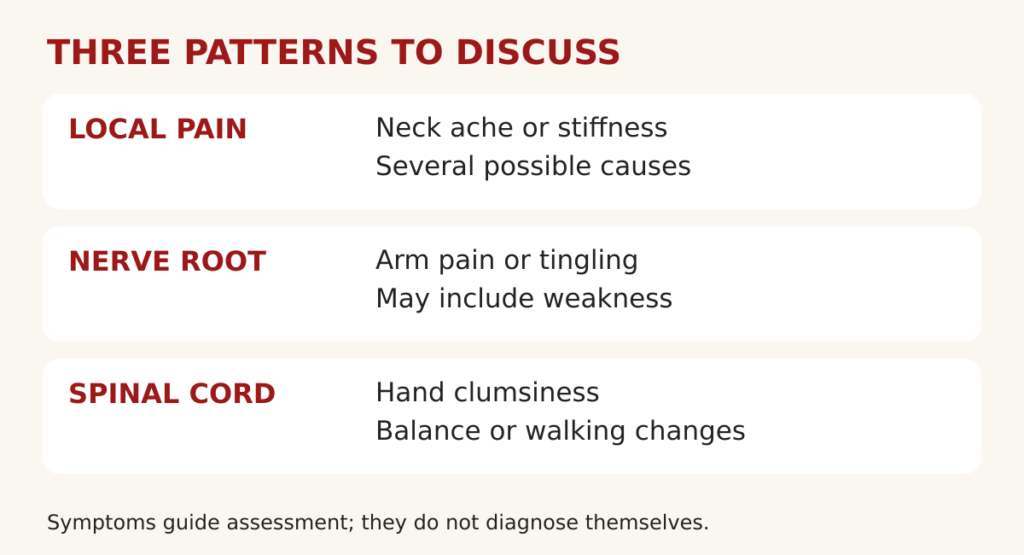
1. Pain mainly in the neck
Local aching, stiffness and discomfort with movement can occur with mechanical neck pain. Muscular strain and other causes may coexist with age-related changes. Pain severity alone cannot tell us which structure is responsible. Your doctor will also consider the history, movement pattern and examination rather than simply matching every ache to the X-ray.
2. Pain or altered sensation down an arm
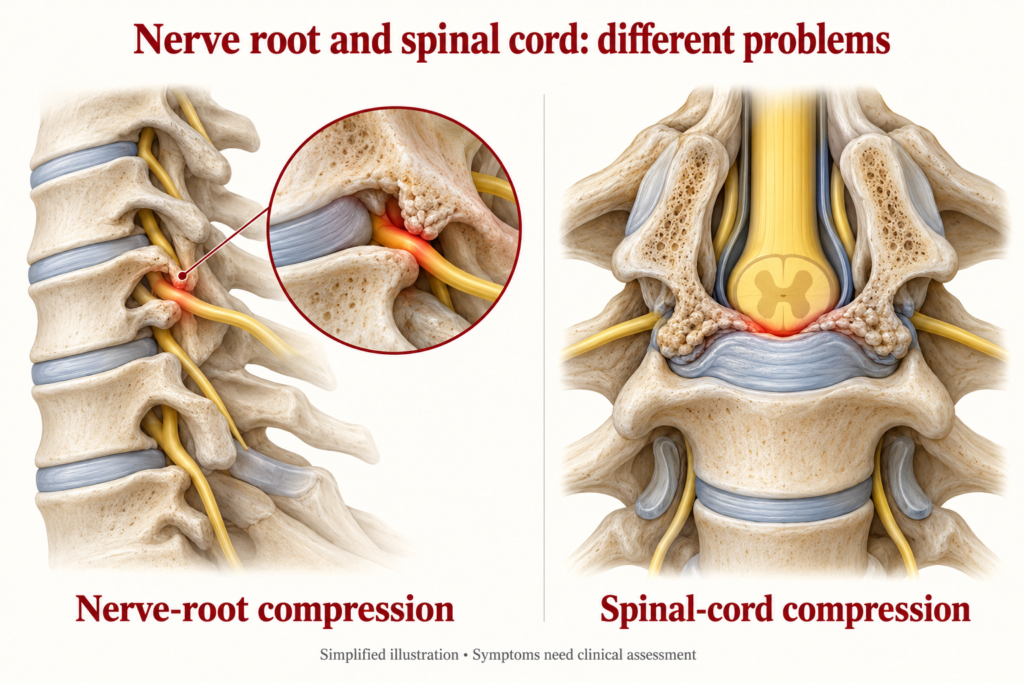
Pain travelling from the neck towards the arm or hand, especially with tingling, numbness or weakness, may indicate irritation or compression of a nerve root. This is called cervical radiculopathy. The pattern of symptoms, strength, sensation and reflexes helps determine whether an imaging finding is relevant. Arm pain can also have other causes, so the symptoms require assessment rather than self-diagnosis. [2]
3. Changes in hand control, balance or walking
Difficulty fastening buttons, handwriting that has become less controlled, repeatedly dropping objects, or increasing unsteadiness may suggest spinal-cord dysfunction, called myelopathy. These problems can be more important than the intensity of neck pain. Degenerative cervical myelopathy involves pressure on the spinal cord; disrupted circulation may contribute to cord injury. It is different from a single irritated nerve root. [3]
In my clinical assessment, I ask about these ordinary daily tasks because patients may mention “neck pain” without volunteering that they have started struggling with a spoon or their shirt buttons. Tell your doctor about changes in function, even if they seem unrelated to your neck.
Read more about common causes of neck pain and warning sign

When should you seek help?
Arrange assessment for pain that persists, repeatedly interrupts sleep or limits normal activities. Seek prompt medical review for new arm symptoms, hand clumsiness, worsening balance or increasing weakness. Do not wait for a routine follow-up if neurological symptoms are progressing.
URGENT WARNING: New difficulty walking, sudden loss of coordination, or new loss of bladder or bowel control needs emergency assessment. Do not assume these symptoms are “just spondylosis”. [4]
Neck pain after significant injury, or neck stiffness with fever, severe headache or feeling very unwell, needs urgent assessment for other causes. Infection is not a routine explanation for everyday neck ache, but it must not be missed when the clinical picture suggests it. [8]
Do you need an X-ray or MRI?
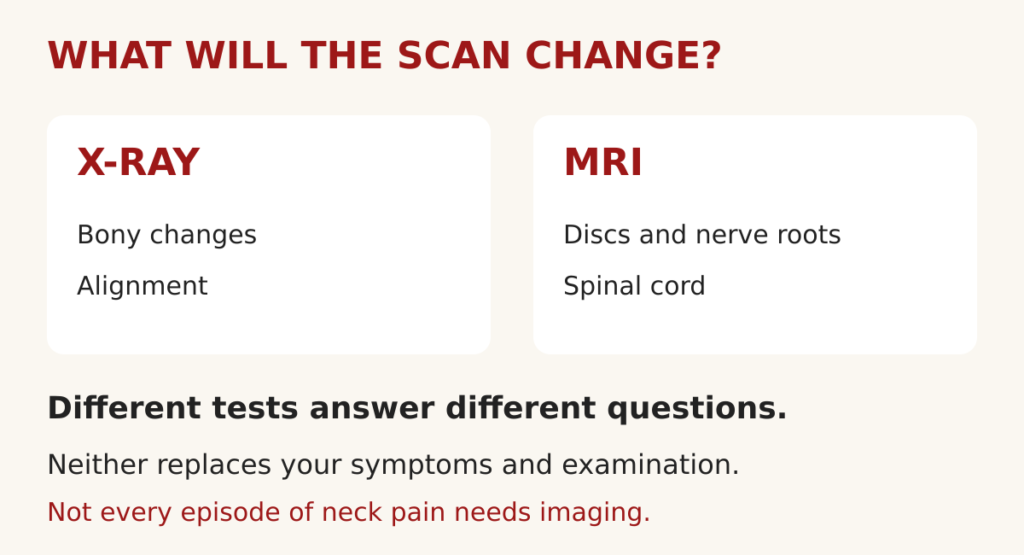
An X-ray can show alignment and bony changes. MRI provides more information about discs, nerve roots and the spinal cord. They answer different questions; neither replaces an examination. [1,2]
There is no universal rule that neck pain lasting three to five days requires an X-ray. In uncomplicated acute neck pain, radiographs may be appropriate depending on the clinical circumstances; MRI is generally not the first investigation when there are no neurological findings or other warning signs. The useful question is: “What are we looking for, and how would the result change treatment?” [5]
MRI is more relevant when the clinician suspects spinal-cord involvement, progressive neurological deficits or persistent nerve-root symptoms that need further evaluation. Repeating scans simply to count age-related changes is not the same as monitoring your recovery. [2,3,5]
What does treatment usually involve?
For uncomplicated neck pain, my initial approach is to reduce activities that clearly aggravate symptoms, use medication selectively when appropriate, and build towards a tolerable exercise programme. This is relative rest, not a prescription to stop all activity.
I usually review patients after approximately seven to ten days when starting medication. At review, I ask about sleep, daily tasks, arm symptoms and function, not only the pain score. That interval is my practice preference, not a guarantee that everyone will improve within a week. New weakness or walking changes require earlier attention.
Movement and strengthening
Gentle movement and progressively introduced exercises are central to longer-term management. Start within a comfortable range and progress according to symptoms and professional advice. Moving your own neck is active exercise; someone forcing it into a stretch is a different intervention. I discourage forceful neck manoeuvres and unsupervised traction.
If an exercise produces new radiating pain, numbness or weakness, stop and seek advice. People with suspected cord involvement, significant injury or recent surgery need an individual plan rather than a generic online exercise routine.
Medication and comfort measures
Medication may help selected patients stay comfortable enough to move and sleep. It should support recovery, not become the only strategy. Anti-inflammatory medicines and muscle relaxants are not suitable for everyone; treatment choice depends on health conditions, other medicines and potential adverse effects. Muscle relaxants may cause drowsiness. Avoid repeatedly restarting old prescriptions without advice. [1,8]
Gentle warmth can provide comfort; protect the skin and avoid excessive heat. Medicated anti-inflammatory gels can have a genuine pharmacological effect. Evidence supports some topical NSAIDs for acute musculoskeletal pain, but this does not mean a gel reverses cervical degeneration or treats spinal-cord compression. [6]
Collars and pillows
I discourage routine prolonged collar use for uncomplicated neck pain. A collar prescribed for an injury or after an operation is a different situation and should follow the treating team’s instructions.
There is also no blanket rule that everyone with spondylosis should sleep without a pillow. I advise choosing support that feels comfortable and does not force the neck into an awkward position. An expensive “orthopaedic” label is not a substitute for comfort and an appropriate assessment.
Learn more about comfortable sleeping positions and pillow support.
Practical advice for everyday life

For desk workers, alternate tasks and change position rather than trying to freeze in a supposedly perfect posture. For homemakers, bring frequently used work closer and break up long periods of looking down. For drivers, take breaks when safe and avoid driving if neck movement or medication makes it unsafe. Older adults should not abandon comfortable walking or light daily activities solely because a report mentions degeneration.
My emphasis is on a realistic plan: activities you can continue, exercises you can sustain, and clear instructions about what to do if symptoms change. The goal is confidence and function, not dependence on repeated pain medication.
For practical screen-use advice, read our guide to text neck
Does cervical spondylosis need surgery?
The word “spondylosis” is not an operation indication. Many people with nerve-root symptoms improve without surgery. Persistent disabling radicular symptoms with matching compression may lead to a surgical discussion when appropriate nonsurgical care has not helped. [2]
Spinal-cord dysfunction requires a different approach. Guidelines recommend surgery for moderate or severe degenerative cervical myelopathy. For selected mild cases, surgery or a supervised rehabilitation trial may be considered, with surgery advised if neurological deterioration occurs. Assessment should not be delayed by repeated courses of painkillers when function is worsening. [7]
In surgical discussions, I distinguish arm pain from isolated neck pain. Relief of arm pain from a clearly compressed nerve is generally a more predictable goal than relief of isolated axial neck pain. For myelopathy, preventing further deterioration is an important aim; improvement may occur, but complete recovery cannot be promised. The proposed procedure must have a clear goal that matches the patient’s problem.
Can you feel better while the scan still shows degeneration?
Yes. Symptom improvement does not require age-related changes to disappear. Flare-ups may occur, but pain is not guaranteed to return and disability is not inevitable. A useful recovery plan includes maintaining tolerable activity, continuing suitable exercises and knowing when a change in symptoms needs reassessment. [4]
At follow-up, useful questions include: “Am I sleeping better? Can I manage my usual tasks? Are my hands working normally? Is my walking steady?” These tell us more about your daily progress than the word “degeneration” on its own.
REMEMBER: Age-related changes are common. Your symptoms and examination guide treatment. Keep moving within tolerance, and take new neurological changes seriously.
Author
Dr Abhishek Ray, Orthopaedic & Spine Surgeon
Ekam Healthcare, Ambuja, City Centre, Durgapur, West Bengal
Appointments: +91 7797046722 | www.boneandspinecare.com
This article provides general education and does not replace an individual clinical assessment.
References
1. American Academy of Orthopaedic Surgeons. Cervical Spondylosis (Arthritis of the Neck). https://www.orthoinfo.org/diseases–conditions/cervical-spondylosis-arthritis-of-the-neck/
2. American Academy of Orthopaedic Surgeons. Cervical Radiculopathy (Pinched Nerve). https://www.orthoinfo.org/diseases–conditions/cervical-radiculopathy-pinched-nerve/
3. American Academy of Orthopaedic Surgeons. Cervical Spondylotic Myelopathy (Spinal Cord Compression). https://www.orthoinfo.org/diseases–conditions/cervical-spondylotic-myelopathy-spinal-cord-compression?webid=2FDEE455
4. NHS. Cervical spondylosis. https://www.nhs.uk/conditions/cervical-spondylosis/
5. American College of Radiology. ACR Appropriateness Criteria: Cervical Pain or Cervical Radiculopathy, revised 2024. https://acsearch.acr.org/docs/69426/Narrative
6. Cochrane. Topical non-steroidal anti-inflammatory drugs for acute musculoskeletal pain in adults. https://www.cochrane.org/evidence/CD007402_topical-non-steroidal-anti-inflammatory-drugs-acute-musculoskeletal-pain-adults
7. Fehlings MG et al. A Clinical Practice Guideline for the Management of Patients With Degenerative Cervical Myelopathy. Global Spine Journal. 2017;7(3 Suppl):70S–83S. https://pubmed.ncbi.nlm.nih.gov/29164035/
8. American Association of Neurological Surgeons. Neck Pain. https://www.aans.org/patients/conditions-treatments/neck-pain/